
A real-life case study from AY 2024-25
Introduction: When a Routine Filing Turned into a Six-Month Journey
Income-tax compliance is often perceived as a mechanical annual exercise—file the return, pay taxes, and move on. But every now and then, a seemingly routine filing evolves into a rigorous test of documentation, interpretation of law, and professional representation.
This blog narrates one such faceless assessment case for Assessment Year 2024-25, where timely revisions, precise replies, and a clear understanding of tax law helped conclude the proceedings smoothly—much to the relief and satisfaction of the client.
What made this case special was not just the volume of income or the multiple heads involved, but the way the faceless system examined every detail before arriving at a fair conclusion.
The Beginning: A Comprehensive Return with Income from All Five Heads
The journey began with the filing of the original Income Tax Return (ITR) for AY 2024-25 for one of our major clients.
The client had income under all five heads of income, namely:
- Salary
- House Property
- Profits and Gains of Business or Profession
- Capital Gains
- Income from Other Sources
Such returns naturally demand extra care, as they involve multiple data points, cross-verifications, and reconciliations with Form 26AS, AIS, and supporting documents.
The return was filed diligently, backed by salary slips, Form 16, capital gains statements, rental income details, business records, and GST returns. At that point, everything appeared complete and compliant.
The Twist: A Forgotten Partnership Income
Sometime after filing the original return, the client recalled an important detail.
During the financial year, the client had received a share of profit from a partnership firm in which there were three partners, including our client. This income, although credited to the client’s bank account, had not been considered while filing the original return.
Now, under the Income-tax Act, share of profit received from a partnership firm is exempt in the hands of the partner, provided the firm has already paid tax on such income.
Ignoring this income even though exempt could create mismatches and unnecessary questions later. Hence, it was prudent to correct the return proactively.
Course Correction: Filing of Revised Return
Acting responsibly, we filed a revised return under the provisions of the Act, disclosing:
- The share of profit received from the partnership firm
- The same shown correctly under Exempt Income
The revision was transparent, lawful, and supported by facts. At that stage, the intent was simple full disclosure with correct tax treatment.
Little did we know that this revision would soon place the case under the scanner of the faceless assessment system.
The Notice Arrives: Selection for Faceless Assessment
On 28/06/2025, the client received a Notice under Section 143(2) through the faceless assessment system of the Income Tax Department.
The reasons for selection were not explicitly stated, but it was fairly evident that:
- Income from all five heads was on the higher side
- A revised return had been filed
- A substantial amount was disclosed as exempt income
These factors often trigger scrutiny under automated risk parameters.
For the client, this notice caused anxiety. For us as professionals, it marked the beginning of a process that demanded calm, clarity, and precision.
Round One: Explaining the Original Return
In the first round of proceedings, the Assessing Officer (AO) requested complete details and documents based on which the original return was filed.
We responded comprehensively, submitting:
- Salary slips and Form 16
- Capital gains computation and supporting statements
- Rental income details and home loan interest documents
- Form 26AS and AIS reconciliation
- Business bills, expense details, and GST returns
Each document was properly indexed, clearly named, and logically explained. The reply was structured to make the officer’s job easier because in faceless assessment, clarity replaces conversation.
Round Two: The Core Question — Why the Revision?
After reviewing the first set of submissions, the AO raised the most critical question:
Why was the return revised, and why has such a huge amount been shown as exempt income?
This was the heart of the case.
We explained, point by point, that the revision was necessitated due to the receipt of share of profit from a partnership firm, which is exempt in the hands of the partner, as tax is already paid at the firm level.
But explanation alone is never enough in faceless proceedings. Evidence is everything.
Round Three: Backing Law with Documents
To substantiate our claim, we submitted a robust set of documents, including:
- Income Tax Return of the partnership firm
- Partnership deed, clearly establishing the client as a partner
- Financial statements of the firm
- Bank statements, evidencing actual distribution of profit
- Confirmation that the firm had duly paid tax before distribution
The reply connected the dots from law to facts to figures leaving no room for ambiguity.
The Waiting Period: Patience Meets Process
Faceless assessment is efficient, but not instant.
From 28/06/2025 to 01/01/2026, the case went through:
- Three rounds of notices and replies
- Multiple internal verifications by the department
- A careful review of exempt income claims
Each response was time-bound, accurate, and focused. No unnecessary arguments. No emotional language. Just facts, law, and documents.
The Happy Ending: Closure on New Year’s Day
On 01/01/2026, the proceedings were closed on a positive note, with the Assessing Officer fully satisfied with the explanations and evidence provided.
No additions.
No disallowances.
No litigation.
The client’s relief was evident. More importantly, the client expressed genuine appreciation that the replies were:
- Apt
- To the point
- Technically sound
- Professionally presented
Important Timelines Every Taxpayer Must Know
Time Limit for Completion of Assessment
For scrutiny assessments under Section 143(3):
- The assessment must be completed within 12 months from the end of the relevant Assessment Year
- For AY 2024-25, assessment can generally be completed on or before 31/03/2026
Time Limit to Reopen a Case
Under Section 148:
- Cases can generally be reopened up to 3 years from the end of the relevant AY
- Up to 10 years in cases involving income escaping assessment exceeding specified limits, subject to strict conditions
Understanding these timelines helps taxpayers stay alert and compliant.
Key Learnings from This Case
- Always revise returns when errors are noticed silence creates bigger problems
- Exempt income must be disclosed with evidence
- Faceless assessment rewards clarity and documentation, not verbosity
- Professional drafting can make or break an assessment
- Preparation today prevents litigation tomorrow
Conclusion: Faceless, Yet Fair
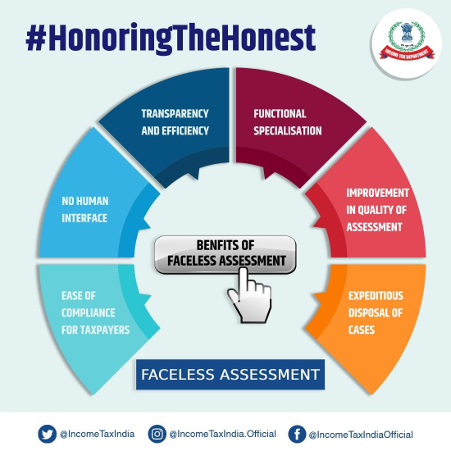
This case beautifully demonstrates that faceless assessment is not something to fear, provided disclosures are honest and replies are well-prepared.
When law, facts, and documentation move in the same direction, even a six-month scrutiny process can end smoothly with a satisfied officer and a happy client.